Description

A blog with some news, reports and articles from the Aikido community around the world.
Edited by Lawrence Warry & Ze'ev Erlich

Sunday, September 2, 2018

Yamashima Sensei in The Netherlands & Belgium 10 - 17 September

Click this image, here-below, to see Yamashima Sensei's Netherlands and Belgium Schedule for the week 10th to 17th of September

Friday, August 24, 2018

Aikido and The Way of Happiness

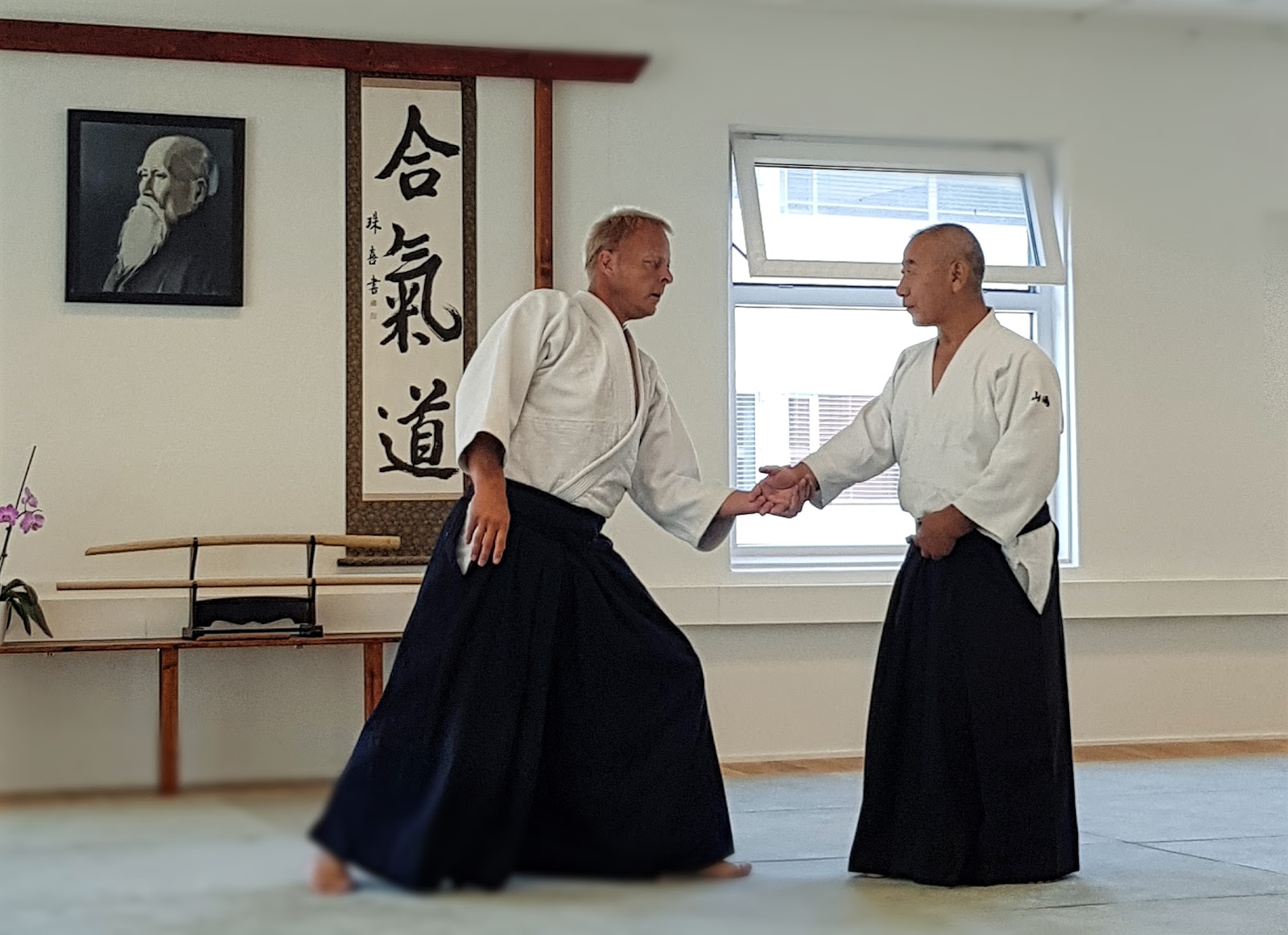
Interview Takeshi Yamashima Sensei (TY), 7th dan Aikikai, international Aikido master, head instructor of Chiyoda and Nerima Aikido dojos, Tokyo. Former dojo-cho of Tokyo Local government Aikido dojo.
Interviewer, Lawrence John Warry (LW), founder of Shinyu Body & Mind Aikido dojos, Amsterdam and The Hague, The Netherlands, seized the opportunity to talk with Yamashima sensei at the lobby of the Thon Linne Hotel, Oslo during his summer seminar on August 12th 2018 (August 2018 tour of Norway and Sweden).
My thanks to Peter and Anna Spangfort for organizing the Norway and Sweden tours every year and my thanks to Ellet Bjerlemo, long time Aikidoka, who made some contributions to the questions asked.
Yamashima sensei, 75 years old, started Aikido at Hosei University, Tokyo Japan, in 1961 under instruction of Arikawa and Yamada shihans. Later, at the world headquarters, The Hombu dojo, Yamaguchi and Osawa shihans became major influences on Yamashima sensei's development in Aikido. With 57 years of experience behind him, Yamashima sensei remains one of the most inspiring and yet modest Aikido teachers around. Soft and gentle in contact, his centre and grounding is, however, very powerful and firm. Yamashima sensei has spent years travelling and visiting Aikido dojos all around the world for his practice. Attracted by his simple and gentle Aikido style, most dojos seek to invite Yamashima sensei on a yearly basis. Due to a growing number of dojos showing interest, Yamashima sensei's travel agenda has grown year by year, to the extent that he is many times in the year abroad! "It's possible because I have an understanding wife and good students at my dojos in Chiyoda and Nerima to take over my classes when I'm away" he chuckles with a smile. Yamashima sensei is not a hombu assigned shihan and, therefore, his invitations are always made independently by host dojos.

LW: Sensei, how did you begin Aikido all those years ago?
TY: Well, it all started because I was looking for something to do. Maybe a little bored from studying at university I was looking for something to spice up my life. My first idea was to learn sailing. I had a dream to sail a boat and I wanted to learn how to do this. But sailing was not easy if you lived in Tokyo. It required getting to the seaside each time and this proved to be difficult for investing the time. Then I came across a poster about Aikido and I thought now that can be something for me. I was curious about how to work with force easily without resisting (it's a bit like sailing). In autumn of 1961, I attended my first Aikido lesson at Hosei University Aikido Doukoukai. I liked what the teacher was showing. It seemed to be a very interesting way to deal with force of the partner. That first class made me curious to learn more. So I just continued, and, here I am today, 57 years later, still practicing Aikido. It is still very interesting for me. I never got bored of trying to understand how Aikido works.
LW: What do you dream of in Aikido?
TY: I dream about the founder, O-Sensei. I want to imagine that I am a good student of O-Sensei, and that I try to understand what O-Sensei was doing when he was alive. It is a big mystery for me but I dream that I can understand one day.
LW: And what is your dream for the future of Aikido and for the people who practice Aikido?
TY: I hope and dream that everybody who practices Aikido will always be happy. I hope that the people doing Aikido continue to find out new ways of practicing and making new good ideas in Aikido so that they can keep it interesting and fascinating. In this way, Aikido will never stop and the people doing Aikido will have a lifetime of joy in practicing and this, in turn, can help people to make their daily lives more easy going and less stressful.
LW: You make contact yearly with literally thousands of Aikido students all over the world. It is no wonder that you started to gain a global following. I've often heard people ask you about examination. I know for you it is a no go to make an examination outside of Japan. Can you clarify why you don't do this?
TY: There is no need to do this. I just concentrate on coming to practice. These days, outside of Japan, there are many high ranking Aikikai teachers who can make examination. So, I don't need to do that job. Sometimes it is important to make examination and sometimes there is no need. In addition, the hombu dojo provides a good method for examination which involves sending the official Hombu dojo shihans to respective countries for examination. This way is working very well and I don't need to be involved in it. I like to just go and practice around the world and enjoy different food and cultures. It's that simple.
LW: Do you have a good relation to the Hombu dojo and to Doshu Moriteru Ueshiba?
TY: Of course. I practice regularly with Doshu. Two or three times per week I will come to the classes of Doshu or Waka sensei. The hombu dojo is a very important place for international Aikido. O-Sensei taught at the hombu dojo. I’m happy to practice Aikido at the place where O-Sensei was teaching.
LW: How long do you know Doshu Moriteru Ueshiba?
TY: I started to practice with him and get to know him around the time he became the successor of his father, Kisshomaru. At that time he was teaching more and more in the Hombu dojo, around the late 1990s.
LW: You also knew former Doshu, Kisshomaru Ueshiba I believe?
TY: Yes, I knew Doshu Kisshomaru very well. He always would give the morning classes at the Hombu dojo, which I attended weekly. I have a lot of fond memories of practicing with Doshu Kisshomaru. It was always a very joyful time.
LW: How did you start to teach Aikido?
TY: After graduating from Hosei university, 49 years ago, I entered the Japanese workforce, working for the Japanese local government, at the ministry of the environment. In the government office, there was an aikido dojo and I started to give the classes there.
LW: How did you start teaching internationally?
TY: I often joined Aikido group trips with Masuda shihan who visited on behalf of the Hombu dojo. He would take Aikido groups to Hawaii, Singapore and New Zealand. Eventually, around the time when I retired from work, in 2002, some Hawaiian and New Zealand members approached me and asked me to come and give lessons. In Europe, I was first invited by Bath Aikido Society in England. This eventually expanded as people from more and more different countries joined the practices and asked me to visit their dojos. Later, students would also come to Tokyo and would invite me then to come to their dojos.
LW: I remember inviting you, sensei, in 2008, to come to The Netherlands for the first time. This was at a time when the Aikido group I practiced with, the CABN, no longer had Fujita Shihan coming for health reasons. You brought a fresh new perspective of Aikido which everybody practicing in The Netherlands loved and enjoyed to practice with you.
TY: I could see how everybody in The Netherlands group you invited me to loved Masatake Fujita sensei and it was a strange feeling for me to be in this atmosphere but I could enjoy Aikido with you and the members of the CABN because everybody was so friendly and hospitable. Thank you very much.
LW: You actually share the same original teacher as Fujita shihan even though your Aikido paths were different later on. Both of you learned under Arikawa shihan, I understand. Later you learned under Yamaguchi shihan. To what extent are these two teachers an influence in your Aikido today?
TY: On the whole, the bigger movements of both teachers are still very much a part of my practice. I still feel many things from Arikawa shihan and from Yamaguchi shihan but I cannot say what is a specific aspect of their teaching which I integrated into my body. I feel that I am not doing one style or the other but that I started making my own ideas and developing from those ideas together with what I learned from the teachers before me.
LW: How did your student to teacher relationship develop with Yamaguchi shihan?
TY: I knew Yamaguchi shihan for about 20 years. He started teaching at Chiyoda Aikido club when Saotome shihan moved to USA to start his life there. I attended many times the gashukus (group camps) of Yamaguchi sensei in Japan (Izu gashuku being particularly memorable).
LW: Your Aikido practice is very physical even though you are soft and gentle with the practice partner. To what extent can you say that Ki is developed in your practice?
TY: Ki is a very subtle concept and if you only think to train Ki as an energetic practice you may fall in the trap that you are just making psychological tricks. Ki has a physical aspect on a subtle level and I believe can only be practiced first in a physical way. It is not something you can think to fake. I practice physically because with the physical development, I believe the more subtle Ki energetic levels are reached after many many times repeating the practice. So in this way Ki is developed but not in an obvious way.
LW: At the end of the lesson today, one of the students asked you about the feeling of “heavy hand”. How can you explain this in words?
TY: I’d say it’s not something which is explainable in exact terms. Except that heaviness of any physical object follows Newtonian laws. For the rest it is a question of regularly investigating what the body is holding that stops the hands being heavy. It can only really be understood by continued practice.
LW: Many students often wonder how can they do better after each Aikido practice. What do you think after you made a practice?
TY: I actually don’t think too much about the lesson (smiles). I like to drink a small beer and eat a little bit of food. The time when we practice is the time when we should be researching and thinking about how to do Aikido better. After practice, it is a matter of living normal life and not being too concerned about what went wrong or right in the Aikido lesson. Please enjoy a drink after practice and please enjoy life.
LW: I understand you saw the founder, O-Sensei, teaching Aikido. What can you say about this experience?
TY: When I watched O-Sensei moving, I didn't understand what he was doing. For me it was very mysterious. I saw him teaching in his later years, between 70 and 80 years old. When he was younger he was very physical but, with time, he became more and more light. At the time I saw him, it seemed like he was almost doing nothing and yet he was doing something. He was moving in a mysterious way I could not understand. Still today I find it difficult to understand but one day I hope to understand it.
LW: Is there anywhere you haven't been in the world that you would still like to go to practice Aikido?
TY: I don't know. Maybe I'm too old now. So I didn't think about it. Maybe some places are too far away now. I guess it depends on the place and if I am invited (smiling).
LW: My final question for you sensei. It seems you are always happy. What is the secret to this constant happiness?
TY: There is no secret (smiling). Everybody can be happy. Just thinking about how to connect the body and mind every day gives good feelings all the time. I want that everybody can think this way and feel good. Especially with older people, it becomes more and more important to practice and think about the body/mind connection. Even when your body is getting older and more tired, you can find happiness in just showing up and doing the practice. When you try to make a better understanding of body-mind connection you make progress and you feel good and happy and you have a better well-being. Get out of the house and try every day to practice.
LW: Yamashima sensei, thank you very much for this interview. It's a big pleasure to talk with you, and to practice Aikido with you. I hope we can practice together many more times in the future. Until the next practice!
TY: Arigatou! Take care!

Tuesday, March 14, 2017

Jan - Mar 2017

1.0 What Does it Take to Give a TEDx Talk?


It's been some start to the year!
I spent the first two months this year preparing for and participating in a TEDx talk. I never imagined I would stand up on stage in front of 200 people in the Transylvanian city of Targu Mures and give a TEDx talk about my childhood and how I entered the martial arts later in life and finally how I came accross the amazing art of Aikido and the wonderful personal development tool and simulation the Samurai Game. In the talk I share my idea about leadership and how it can be achieved without brute force or manipulation but by the simple power of surrendering, not so much in a submissive way but by way of permission, just like we practice in Aikido.
The talk in Targu Mures was well organised by Dr. Johann Stan, the TEDx curator of Targu Mures. Dr. Stan did an excellent job of collecting some of the most forward thinking people of Romania together as well as the two visitors from The Netherlands (myself and Mr. Maurice Zondag) to come up with what can only be described as an inspirational day of great ideas being shared by the speakers. From social-psychology to technical insights the talks of the day gave members a taste of what is to come in the future and the challenges we are faced with that come with the changes. My talk, Surrender for Effective Leadership, was therefore very fitting as I tried to bring to the surface issues of modern diversity and the need to cross tribes in order to form new tribal leadership if we are going to develop super teams to take on tomorrow's challenges.

The preparation was an arduous challenge in itself. I spent weeks writing and correcting the transcript until I came to a version which I and my friends who collaborated with me found to be acceptable. I made rehearsal talks with friends, online, over the phone, in my bed to mysef, on the toilet, in the car. Any chance I could get to rehearse the talk, I seized the opportunity! It is with thanks to Aikido which taught me diligence that I was able to carry myself through the practice and preparations daily for a period of two months. I never imagined I would be ready but, there I was, on the day, standing up and talking my talk. It was an exhilarating moment and most memorable will be when I got the 200 strong audience to stand up with me and practice the GRACE exercise that George Leonard adopted in the Samurai Game. GRACE stands for Grounding, Relaxation, Awareness, Centering and Energizing. It was really something to see. Me and 200 people breathing in synchrony. I started to feel what it might be like if I was Mr. Bikram himself giving one of his hot yoga classes.
Whilst it lasted just a minute or so to do this exercise with the audience, the effect was a deep sense of connection and the stunt hit home the message that we need exercises like GRACE to break down barriers between diverse perspectives and cultures.

The additional challenge of the talk was to relay my message within a limit of 18 or so minutes. This is a requirement of the TED organization and the TEDx organisers are obliged to ask the speakers to respect this time.

The event itself was well run by a team of enthusiastic students who believed in the TED philosophy of ideas worth spreading and these young individuals were very helpful in keeping the show smoothly running all day. Therefore I present my deepest thanks to this wonderful organisational team and Dr. Stan.

The talk I presented will soon be online and I'll be announcing it on this blog and on Facebook.
In the meantime, if you're curious about the contents of the talk, I have also made the transcript available online, which quite surprisingly is quite close to the actual talk I gave despite the fact that I threw my index cards with the key points into the air and surrendered to the limitations of my memory!

Link to transcript:
https://docs.google.com/document/d/1pTwJDzOdECGES9sWMCnEwoVRZsx3tHRAuAwAQVlf9UA/edit?usp=drivesdk

2.0 Celebrating One Year of Aikido in Amsterdam

Back in March 2016, a new baby Aikido club was born, Shinyu Amsterdam Dojo of Aikido and Embodiment. We started with just 20 mats and one student. Over the year, we didn't grow much in numbers but we had a fantastic Aikido learning. Three great teachers came to visit us: Ze'ev Erlich Sensei and Miles Kessler Sensei (both from Israel and both 5th dan Aikikai) and, most auspisciously, we also received the practice of Takeshi Yamashima Sensei 7th dan Aikikai.
We are deeply thankful for all the support of our teachers and students who applied themselves over the year to our little Aikido club and we look forward to further expanding our knowledge and sharing Aikido with more people over the coming years! The plan is also to expand to two time per week practice. Keep your eyes peeled here on Facebook for more info: https://www.facebook.com/shinyuaikidoamsterdam/?fref=ts


https://www.facebook.com/shinyuaikidoamsterdam/?fref=ts


Friday, May 6, 2016

May 2016

Why Aiki?

First of all I'd like to apologize for being away for so long. The last post was indeed the end of last year. It has taken a few months of change in my personal life before I could collect myself and get back into blogging. My personal change process has brought me to look at this blog also in a new light. Rather than making a deadline for the next issue, I will blog as I feel and you will get posts from me more or less real-time according to moments of inspiration that I gain throughout the year.
Such an inspiration arose now after reflecting on starting a new Aikido group in Amsterdam and the development of the Aikido group I started up in the Hague 2 years ago.
My inspiring moment came up when I realized that beginner students tend to grasp quickly the notion of "Ki" (the concept of universal energy, such as prana in Yoga and chi in Thai Chi) but not "Aiki". Aiki is the idea of joining energies/connecting/being one with others.
So, it lead me to the question: "Why Aiki?". Why should we put so much emphasis in joining Ki in particular. What is the benefit of doing this and how do we project that learning to the beginner?
If the "Ai" part was not so important, O-Sensei would have just invented the art as "Ki-Do" (the way of Ki or universal energy)?
After all this is what yoga is in some way. It is the way of "prana" (prana being the sanskrit equivalent of Ki). In a similar way, Tai Chi and Chi Gung are ways of cultivating Chi (the Chinese for Ki). And, without under-estimating the intricacies that go with a deep learning of the yoga traditions and Chinese martial traditions, the question lies nevertheless therein, what does the "Ai" bring further to Aikido than mere Ki development?
Ultimately, the "Ai" is the linking factor in the mystery and mastery of Aikido. The founder of Aikido, O-Sensei explained Aiki as that which impels any attacker not further to think about attacking and thereby harmony being generated in one's environment.
Literal quote from O-Sensei: "At the energetic and spiritual levels there is no separation between the tori and the uke in Aikido. Aikido takes us out of the illusion of separation/ attack".
This is probably the most difficult aspect of Aikido to grasp for a beginner. How can you imagine a real attack and Aikido's answer being "it's just an illusion"? So it takes some patience of the teacher (and students) before the student's mind transforms into another way of thinking and before we can really practice Aiki. What is the use of practicing such a thing when the rest of the world is talking about the attack in another way (even if it is an illusion of an attack)? Well, that leads to the title of this article! Why Aiki?
Practicing the "Aiki" aspect of Aikido has many different forms. One can practice it with aligning weapons (for example bokken practice, wherein attacking movements are fused and blended). One also practices Aiki in the connection exercises for both uke and tori. After some time of practicing Aikido, the beginner transforms into an intermediate. The turning point is the moment when the student not only practices technique but also tries to put Aiki into what they practice.
When Aiki is added, the practice gains a new dynamic. Movements are less rigid. The breathing of uke and tori are unified. The responses are smoother and better carried out due to the partner's impulses being felt and acknowledged. The uke and tori deepen their awareness of their centers, of their limitations, of their focus, of themselves, and, of one another. They essentially become more engaged and the whole movement becomes one body instead of two bodies moving.
So, Aiki becomes the essence of what is Aikido. It is what makes it stand out from just being a martial art or just developing Ki. When there is Aiki there is the attainment of enlightenment and the doing away with any winner or any loser. It's the ideal, of course, and we all have a long way to go. The higher one goes up in rank the more humble one should be to this realization and, there, we have the spiritual message of Aikido. It's not obvious in the beginning why Aikido should be a spiritual practice. In the same way it's not obvious how music could be spiritual for the beginner guitarist or pianist. When we make a practice of anything and we embody it in our lives that practice becomes, in all its glory, a spiritual product of our actions.
The fact that the beginner has not practiced much is the very reason, therefore, why Aiki and it's spiritual realization is so very difficult to grasp. Despite the road being a long one the Aiki concept is important to know from the beginning and it's important that we try each time to realize it even if we fail time and time again for it to be realized. But, do not despair beginners! Yes, the journey is long. Remember the old Zen saying, the path is more important (and if I could add, more fun and more educational) than the goal and you'll have a great time of fun and learning on this beautiful journey.

Lawrence Warry

Sunday, November 8, 2015

October - December 2015

Summarizing The Themes
Over the past months, it's been a regularity to focus on some themes which could be relevant to the practice of Aikido. To summarize these themes, I collected them and compiled them all together in this post.

1.0 Let the Mind Expand

How can the mind's imagination be used to become more effective in reaching our physical limitations? We often think we can't do things in physical space because we have limited perceptions of what we can do in mental space. To overcome this, we need a big mind or big imagination. It has been said that O-Sensei talked of imagination as "taking the Sun, the Earth and the Moon, putting them on one stick and swallowing them". This kind of expansive imagination leads to an expansion in physical possibility as a result. Physical potential is not just muscle-strength and flexibility related but also sensorial, coordination, spatial awareness and physical; cognitive connection intelligence. With a big mind, we can expand these qualities in our Aikido development then we can gain a new insight in our abilities to make an Aiki-telligent movement as well as enjoy our experience.

2.0 Energy Center/Hara 腹 
(Belly area, center of power and energy center of the body)
In Budo and of course in Aikido, we put a great deal of of importance on the use of the hara which is both our physical center - our stomach, and also the source for energy (ki), emotions and feelings. In Japan, all of the traditional arts consider Hara as source of creation and movement. Arts such as Tea-Ceremony, Noh, Budo and others are called "Hara-Gei" which means - skill or art of Hara.
It might be difficult for beginners to understand, but advanced students in Aikido, constantly try to develop their hara and to execute their movements and techniques from their Hara. I think that if we practice with a great master, we immediately feel the tremendous amount of energy and power his Hara emits.
The hara in healing is just as important as it is in Aikido and the arts of “Hara-Gei”.
One makes optimal use of one's bodyweight when the shoulders are relaxed, the arms are extended and the hara is engaged. Engaging the hara means not to focus one's head and thoughts on personal problems or the ego but to turn attention to the center of the body, to the belly, to feel the transfer of bodyweight coming from this energy center as one extends ones focus outwards to the task at hand.

3.0 Practicing Patience/GAMAN (我慢)


Gaman is a recurring theme because it is an important theme to remember in our practices. It is one of the highest and most honorable of virtues in the Japanese budo arts/martial arts. It means to bear with, endure or put up with. It is the restraint you need when stressed or provoked. It is holding back when under pressure to act. It is the regular forging and patience necessary in practicing an art. It is being able to not let emotions take control even when there is an emotional opinion in a critical moment. It is enduring difficulties in learning and the slow and sometimes painful climb to mastery. It is declining the invitation to fight and seeking a higher level of resolution and consciousness for ourselves and others.

4. THE DIVINE SWORD!

From the memoires of O-Sensei, founder of Aikido.
The appearance of an "enemy" should be thought of as an opportunity to test the sincerity of one's mental and physical training, to see if one is actually responding according to the divine will. When facing the realm of life and death in the form of an enemy's sword, one must be firmly settled in mind and body, and not at all intimidated; without providing your opponent the slightest opening, control his mind in a flash and move where you will—straight, diagonally, or in any other appropriate direction. Enter deeply, mentally as well as physically, transform your entire body into a true sword, and vanquish your foe. This is yamato-damashei, the principle behind the divine sword that manifests the soul of our nation. In essence, the sword is the soul of a warrior and a manifestation of the true nature of the universe; thus, when you draw a sword you are holding your soul in your hands. Know that when two warriors face each other with swords, the body and soul of each individual is illuminated as they come together in a world that needs to be rid of falsehood and evil. An enemy that appears along the Great Path of divinely inspired swordsmanship enables a warrior to activate universal principles, and thus serves as an aid to the harmonization of all elements of heaven and earth, body and soul— glories that endure forever.

5.0 Applying G.R.A.C.E to change (Developed by the late George Leonard, Aikido teacher and founder of the Samurai Game®). When we enter a new phase of change we may have to adapt to the changes in our environment.
In that case let's try to apply G.R.A.C.E:
Grounding
Relaxation
Awareness
Centering
Energy

6.0 Correct Distance/Mai-aiFrom a martial point of view, mai-ai should be such that one is not within dangerous reach of the other at the same time one is close enough to be connected. This results in about the same distance as the reach of the outer perimeter of our aura in the paranormal studies. It also corresponds to touching swords when practicing with aiki-ken or katana (Japanese sword). With correct mai-ai/space, two separate bodies connect as one body to have a common center. It's interesting that we talk often about our center of gravity or seka tanden (tantien in Chinese), located just below the navel, as our center but there are also connections to be made in our mental and emotional centers and the 7 energetic centers/plexi or chakras running from the pubic bone up to the crown. Crossing different studies such as meditation, yoga and aiki-ken allows us to gain deeper insights to correct spacing between two bodies. This practice is applicable in life to know the correct space/distance to give a person when engaging in a discussion, conflict or negotiation.

7.0 Harmonising Energy and Applied Focus of Energy/Ki AiThe "Ai" and the "Ki" in both terms mean the same and have the same kanji. "Ai" can mean to meet, to fit, to harmonise and love. "Ki" is the universal lifeforce energy that circulates inside and outside of our body, that gives us a healthy spirit to our lives with a positive attitude from day to day.
However the term "Ai Ki" has a slightly different meaning to "Ki Ai".
"Ai Ki" can be considered harmonisation of Ki energy or mutual connection of energetic bodies. "Ki Ai" is considered more on an individual level as an application or concentration of Ki energy on what one is doing. As uke (the receiver) and as tori (the one who leads with the technique), we try to apply Ki Ai in both roles.
When we practice Aikido, therefore, we make connected "Ai Ki" movement with our partners and at the same time apply balance taking and application of Ki energy upon eachother through focused "Ki Ai".
We cultivate Ki Ai with grounding, centering and breath work exercises.

8.0 Studying Nature/Shizen

Finding nature's spirit in everything we do. Aikido is an art form following the way of "shizen". In other words it is a way of nature. We learn nothing more than to be natural in our posture, in our interactions and communication. There is nothing else we have to do.

9.0 Balancing Tension and Relaxation/Meri Hari


"Meri-Hari" expresses the correct balance between tension and relaxation in every day life. It is said that we must not carry today's trouble and tiredness till tomorrow. At the end of each day, we should find time to relax. We should not study or work until we fall asleep. We have some time for relaxing at the end of the day, and we must end it like that. This is not only a healthy and natural way. It is also a way to live in the present moment and to savor each moment. The Meri-Hari concept can be found back in the practice of Aikido as the movement which we make is also a fine balance of tension and relaxation at the different accent points.

10.0 Letting Go and Connection Intelligence


Strangely, in Aikido, we hold on, or appear to hold on. In fact, what appears to be holding on is merely symbolic of realising connection. Although we grab and play a role in staying connected, the idea in Aikido is to gracefully let go without aggression or tearing away. This is subtle and needs a lot of practice. It's kind of an ideology and yet it would be great if we could apply this to conflicts, relationships, peace in the world and beyond in the hope for humans to reach a higher level of consciousness.
Thanks to buddha, we have the famous saying "In The End, Only Three Things Matter: How Much You Loved, How Gently You Lived, and How Gracefully you Let Go Of Things", although Buddha probably didn't ever say that :-)
Nice to consider it anyway for our Aikido practice and daily lives.

11.0 Rigid Practice/Shugyo


The term Shugyo refers to rigid disciplined practice in order to attain spiritual progress. The goal of practicing Aikido is therefore not only a goal of ability but a goal of spiritual growth through regular practice. In the beginning you might not get it. The more you practice regularly, the more this becomes a clear realization and the mind develops positively.

12.0 Applying Soft Eyes/Metsuke
The Aikido Encyclopedia defines Metsuke as " Eye-to-eye contact without focusing on a single point which permits awareness of the total field of vision". I like to think of it as soft eyes or soft gaze.
In fact metsuke is one of the three fundamental aspects to train in aikido ("1. Metsuke/soft gaze, 2. Mai-ai/fitting distance, 3. Musubi/connection"). All three have to happen for connective flow and blending to occur in the movement. With soft eyes, we are focused as much internally as we are externally and we approach the connective movement in such a way that internal and external are one and the same space, Uke, Tori, and all those around us, are one and the same body. In that state, the room that we are situated in seems not to have walls and our perceptions become expansive and without borders. Try it next time you do Aikido. Make a soft gaze when you practice and notice new levels of awareness.
Funny enough, Metsuke is also the name given to the official band of anti-corruption investigators during Tokugawa times of Japan, that checked nobody was melding with the system.

13.0 Stand Like a Tree/Shizen Tai


Your feet and toes are like roots reaching through the ground towards the center of the Earth. Your legs with knees slightly unlocked form a solid but flexible trunk. Your spine is vertical, reaching the crown of the head, like the trunk's apex, upwards towards the sky. Your shoulders are relaxed and arms and fingers are extended and are flexible like branches in the wind. You absorb the air through your nasal passage into your lungs with an open chest, rib cage fanning open, and you emit a powerful life-force coming from your center of gravity, 2cm under your navel. In this stillness you are like a tree, nurturing life and creating a strong center for vitality and life to revolve around you. This natural standing position is also referred to as Shizen Tai in Japanese.
14.0 Ebb and Flow of Breathing/Kokkyu

"Consider the ebb and flow of the tide. When waves come to strike the shore, they crest and fall, creating a sound. your breath should follow the same pattern, absorbing the entire universe in your belly with each inhalation. Know that we all have access to four treasures: the energy of the sun and moon, the breath of heaven, the breath of earth, and the ebb and flow of the tide."
By O-Sensei - Morihei Ueshiba - Founder of Aikido
Translated by John Stevens Sensei.

15.0 Be The Universe!

/


Self love is the first line of self-protection and self-defence. But in fact Aikido is not self defence in physical fighting terms but self-cultivation in terms of personal development. Aikido cultivates the self in progressively developing our abilities to absorb the attacking force and maintain our ground. By grounding, we keep in touch with our centre and become supple in our responses. Our own self cultivation creates a trust relationship with our training partners as we become more secure in our choices of movement and provide a strong supportive role to others instead of an indecisive unpredictable hesitation. O-sensei said: “Aikido is not an art to fight with enemies and defeat them. It is a way to lead all human beings to live in harmony with each other as though everyone were one family. The secret of aikido is to make yourself become one with the universe and to go along with its natural movements. One who has attained this secret holds the universe in him/herself and can say, ‘I am the universe.’”

16.0 Joining Ki/Musubi

What does it mean to join Ki (気)? When we join Ki (気) we make our connections stronger, we learn and develop collectively, we create harmony in our environment,we improve our power to heal and prevent injuries and we have a better quality of life on an individual and group level. There are many physical practices to help people with developing their own Ki (気) and join their Ki (気) to others. Aikido is specific in doing this.When beginning Aikido, we learn a lot of form and it becomes very much choreographed much the same way as forms are learned in other martial arts. As time goes one, it becomes apparent, that to go futher in Aikido, one has to go beyond technique and form. The subtle energy of Ki must somehow be researched and, for the lucky few, fully understood. When one stops to be busy only with their own ability and how good they are at something a shift occurs and one's consciousness enters a new level to that of the collective.
In investing one's concerns for others instead of themselves, a human being has reached a higher level. I think this would be agreed by the majority of people regardless of whether or not they believed in the existence of Ki. In Aikido, we try to experience the joining of Ki in this way by giving up our individual demands and joining others to realise the common demands between each other. One could regard it as a universal democratic system without political intervention.
On the bottom line, Ki is just a theory with billions of testimonial experiences. So strong is the belief, in fact, that it is not even doubted in most of Asia (Chi being the Chinese version of the word Ki). The term Ki appears frequently in the Japanese language when referring to energy related concepts (for example: Gen-Ki refers to a person's state of health, Ten-Ki refers to the weather or energy of the heavens, Den-Ki refers to electricity).
The theory of connecting Ki extends further into peoples' well-being. Chinese Medicine explains injuries to be caused because Ki is disconnected or can't flow in one's own body. Healing techniques such as those adopted in Reiki and Shiatsu are supposed to be effective by connecting the Ki of the therapist to the patient.
17.0 Uke & Tori

From Ze'ev Erlich of Israel: Each Aikido technique is made of a dialog between Uke and Tori. Uke attacks, and Tori defends. When we watch our sensei's demonstration, we should pay attention not only to sensei's technique. The technique is only half the story. If we pay close attention also to the role of Uke, we will notice that both Uke and Tori are actively responding and maintaining their flow and dynamic correct movements.
Uke's skill is just as important as Tori's skill.
Learning and understanding Uke's movements and posture and each detail of the response, will enable you to protect yourself, understand more deeply the principles of Aikido, and will help you improving your physical and mental condition.

18.0 Disturbing physical balance/Kusushi

There are many ways to achieve kusushi. Many martial arts teach specific techniquesto disturb an attacker's balance. Sometimes, kusushi involves destructive and violent blows.
Aikido goes one step further. How to disturb the physical balance but not harm the person? This is not an easy task, but the ultimate path to peace.
In our practice, we try to minimize the effort we have to make to arrive at the disbalance until we attain ultimate "satori"/enlightenment. One way of thinking of "disturbing the balance" in a paradoxical way is how not to disturb the disbalance that already exists!

19.0 Giving LifeAikido is a life giving art not a life taking martial art. That's why we don't punch or kick or try to make violent movements to eachother. Instead we simply try to connect and share vibrant life energy.

20.0 One Meeting One Chance/Ichi Go-Ichi EIchi go ichi e
How many opportunities do we miss every day/minute/ second? What opportunities do we have in practicing Aikido?

21.0 Take the Hit as a Gift


Taking the hit as a gift. This is a famous quote of George Leonard who wrote a number of Aikido books, including the book called "Mastery". We often take the hits, the negative events, the discomforts of life, and fire something equally negative back. In Aikido, we work on letting go of those instinctive actions and, instead, move to a more centered space where we can contemplate perceived attacks and transform our perceptions into something more positive. It may amount to working on the cracks in our personalities to get there, but, when we do attain clarity, the light is easier to see.
22.0 No Mind/Mushin (無心)

Mushin is a mental state into which very highly trained martial artists are said to enter during combat. They also practice this mental state during everyday activities.My interpretation is that Mushin is a state of egoless focus that allows one to enter situations with assertiveness and courage without backing down or thinking of the consequences. I've heard various translations of the term: no mind/empty mind/innocent mind/beginner's mind.
In Aikido practice, we attain mushin by repeating the exercises rigorously, which can be mentally demanding, without emotional opinion or complaint. To that extent, we aim to maintain our beginner status at all times and make each learning repetition a new experience. To build one's character in attaining mushin is, to my opinion, one of the many useful benefits of Aikido practice.

23.0 Alignment

As was abundantly reported all around the world, on December 21st 2012, all the planets in our solar system were perfectly aligned with each other. For the first time, our Earth, Moon, all 9 planets in our solar system, our Sun and the Pleiades constellation (which is the star system that our Sun orbits) ALL came into direct perfect alignment with the massive black hole that exists at the very center of our Milky Way Galaxy. If that's not amazing enough, this exact alignment only happens once every 200+ million years!
This 2012 event also marked the completion of a 26,000 year solar cycle that our sun is on orbiting Pleiades. This was an event that the Mayans and many other ancient tribes around the planet predicted as symbolising "the end of the world".
What is so interesting for one studying Aikido is that O-Sensei often spoke about the Sun, the Moon and the Earth being Aiki. Here is a doka from O-Sensei:
"The sun, the moon and the earth
All have become Aiki
Standing on this bridge
The great expanse of the sea is
The Way of the Mountain Echo."
Shimamoto shihan of Osaka has been heard to speak of O-Sensei as teaching students to have a big imagination and to imagine placing the sun, the moon and the earth on a stick and swallowing them whole. Many alternative healing theories (such as medical astrology) involve representing celestial bodies with human body parts. One can consider, for example, the alignment of the mind, heart, lungs and stomach as corresponding to aligning celestial bodies in order to create an influence on the environment by way of gravitational force. This is indeed what we try to achieve in disbalancing uke, as a role as tori. For this disbalancing to happen, we have to create the correct alignment in our bodies. We do this by way of hanmi. Hanmi is, indeed, the intentional act that a human has to make in Aikido in order to create such a burst of energetic influence on their training partner. One can parallel such an effect with that of the spring tide which happens when the moon is full or when the sun and the moon are aligned with the earth, causing the combination of gravitational pull, both from the sun and from the moon. If we are to consider our body parts (such as, for example, heart, lungs and stomach, having a gravitational pull of some degree with respect to the earth), then we can also understand that the combined gravitational pull would be achieved when the body parts are aligned, and a corresponding effective force would be established as a consequence.
The alignment we try to perform in hanmi in Aikido, therefore, seems interestingly close to the spring tide effect caused by planetary alignment with the sun and the moon and is an explanation, to those who doubt, as to why one can cause such a big gravitational effect on uke without an exhaustive physical effort.
How close this is to O-Sensei in his idea, I can't gauge and, yet, as to that point, it is not even necessary to consider whether this was O-Sensei's main focus, for the study itself and the progress being achieved is of enough value in its own right to be interesting and to be followed up with further research.

24.0 We are all on the Same Path 
“If all you think about is winning, you will in fact lose everything. Know that both you and your opponents are treading the same path. Envelop adversaries with love, entrust yourself to the natural flow of things, unify ki, body and mind, and efface the boundary between self and other. This opens unlimited possibilities."
- Morihei Ueshiba, Aikido founder.


25.0 Change your shape (or role)! 
We should easily adapt ourselves to each situation. If we feel a stretched out arm from uke, then the movement will naturally become a stretched out movement. If we feel a holding back from uke then the movement will naturally become a more compact introverted movement. And, so it is in daily life. Are we ready to change from the shape of worker at the office to husband, wife or partner at home or to socializer with our friends when going out. We need time to make these daily adjustments. The partner who goes rushing home in work mode trying to be a good and loving partner is going to enter a crisis or inner conflict. There must be a moment of settling and readjusting to prepare to make the shift.


26.0 Centering

Aikido tries to mimic the universal law of centering. Centering can be found in all structures of the universe, large and small. We refer to three different physical centers in Aikido movement (a point, the seka tanden said to be the center of gravity of the body, an area, the hara or belly area said to be the energy center of the body and where one should focus one's intention, and a line, the chushin the central line or conception vessel of the body). All three centers integrate as a unified entity of movement in Aikido.

27.0 Quality of Connection

At some point earlier, we talked about connection intelligence (how, with regular practice, you develop an intelligent and wise way to connect when performing Aikido movement). The quality of connection is just one component of connection intelligence and is well worth a deeper study. It is important for us to deeply consider how we approach the connection situation between uke and tori. We don't want to be so rigid that we cannot move flexibly but at the same time, we don't want to be so loose that the training partner cannot feel our connection anymore. We have to dynamically and continuously set our intentions with awareness and alertness, noticing at all times how points of connection between training partners change from one part of the body to another, from one training partner to the other. The quality of connection may be measured not only in amount of pressure one gives in one's contact but also on many other levels. One such level is the presence of the individual. One can grab unbearably hard and be totally not present. When we explore the different qualities that belong to a connection, we can start to become more aware of how many levels there are that we have to get through in order to truly master Aikido. If we are only busy with technique, we'll be forever stuck with just one level of quality of connection.

28.0 Playing is Learning
George Leonard, writer, thinker, aikido teacher and founder of the Samurai Game® wrote:
"In terms of the game theory, we might say the universe is so constituted as to maximize play. The best games are not those in which all goes smoothly and steadily toward a certain conclusion, but those in which the outcome is always in doubt. Similarly, the geometry of life is designed to keep us at the point of maximum tension between certainty and uncertainty, order and chaos. Every important call is a close one. We survive and evolve by the skin of our teeth. We really wouldn't want it any other way."

29.0 Relax the shoulders! Relax the shoulders to breathe efficiently, to be responsive, to allow ki energy and vitality to flow in your body, to be less stressed, to stretch your body effectively, to move dynamically and fluidly, to be grounded and centred and to relax the mind and allow thoughts to pass by without hanging on to them, to have a happy life.

30.0 Trust the ProcessOk, so you've decided to make a commitment to a certain practice which might take place once, twice, three times per week, or every day. So, what now? What do you do when you don't feel like going to your practice. What do you do when you are prevented from going to your practice (for example, because of bad weather, food poisoning, traffic blockages, or other kinds of preventions)? How can you evaluate the balance between what is a good continuation and what is a much needed rest? The answer is that there is no right answer. There is your practice, the process and there is you. You could parallel it to the car, the road and the driver respectively. You drive the car and it may come along some diversions along the way, sometimes it needs to stop for fuel and the driver sometimes needs a rest but the driver trusts that, with good navigation, the road is good. Sometimes, you may come to some dubious areas which lead to a doubt if you on the right road but, by driving on, you come to realise that this was just a short moment of uncertainty and again, you feel confident you are on the right road on your journey. So it is, in parallel, with the chosen process, with good guidance, the process will lead the practice and you, as the driver, to a good place. You will also come across doubtful moments which maybe do not allow you to trust the stakeholders in your process (the teacher/guider, the other students, yourself even!) but if you go on, you will notice that this was also just a short moment of uncertainty and you will again regain confidence in the process. So, it is important to trust the process as much as you trust a road that you would drive on. Have a good practice!
31.0 Less is More!
We do too much because we think this is what we must do to become bigger, stronger, more excellent, more rich, more amazing at everything. But, in fact, we must 'do' less and just 'be' more. We explore this problem in Aikido movement. Ask yourself when have you done too much. Did you apply too much force to a technique? Did you train too much, making your body tired and injured? Did you think too much? Did you over-try so much that you now even feel inadequate if you don't try? When we back off from "over"-doing, we sit in a wonderful zone of realization where we start to notice the simple and elegant details of each stage in our development and the richness of our most simple of interactions in the practice itself. Remember, the act of not trying/resting does not equate to giving up. It is a very important stage of letting impressions settle and letting the results of your practice materialize in your personal evolution.
The Journey of Practicing
Don't forget the car needs to refuel sometimes. So does the body. Sometimes it gets dark and misty on the road. So does it in the mind. Don't forget to refuel now and again and don't be put off by dark and misty moments. This is all part of the journey!

32.0 Changing Perspectives

In Aikido we find ways in movement of embodying the process of harmony in situations of conflict. We have two basic tools: 1. Irimi: We enter the space of our attacker. 2. Tenkan: We turn and see the world from the the other person's point of view. This combined movement is the movement symbolising empathy; This movement requires courage/bravery to enter into the conflicting confrontation. Irimi and tenkan are therefore the two basic tools of changing perspectives in order to achieve harmony in Aikido.

33.0 Wisdom of Response

The wisdom of response. When we refine our movement over time, we hope to do only what is necessary. We respond only to the impulses given to us and we move in response only as much as the impulse needs us to. Therefore, with practice over time, we reduce the number of unnecessary movements and we allow ourselves to become more authentically responsive to an impulse, by enhancing our awareness of receptivity in our body rather than using reactive thoughts in the head. This is the wisdom of response and of life.

34.0 Knowing Our Limits

Knowing our limits. When we practice an art of any form, we get a deeper insight into our limitations and possibilities and the limitations and possibilities of others. When we are injured or experience change in our lives, we notice the changing state of our limitations and that we have to find new possibilities within the changing state of limitations. In Aikido, the discovery of possibilities of movement and connection, allows us to meet also our limitations in movement and connection. The discovery deepens when we explore the limitations of our balance and how we can give up our balance and allow ourselves to fall without holding back, only to recover from the fall and regain our balance by way of a smooth and uninterrupted or undisturbed transition.


35.0 Stillness in the Storm/Sumikiri
The Japanese term sumikiri means clarity. The stillness in a storm is an expression of sumikiri. From stillness, we find unification with all our surroundings.
O-Sensei, founder of aikido once said "Focus on stillness rather then motion in order to master aikido techniques. For a heart instantaneously at one with the clear and serene sky, all of existence appears in crystal clarity".

36.0 Unbendable Power

Unbendable power. Concentrate on your center and you can allow chaos to happen all around you without being disturbed or disturbing. You will have the strength to let go of the idea of trying to control everything outside and inside yourself. The famous unbendable arm exercise emphasises how by keeping a calm, even and centred focus, stance with weight slightly going down to the front of the feet, arm opened out in a natural position in front of the body, with the fingers of the hand naturally open, your arm is unbendable and unified with your body and your body is grounded and heavy, thus generating an impressive powerful centering position.

Images

Monday, August 17, 2015

July - September 2015

1.0 Aikido and The Art of Happiness

On my last Aikido trip, to pratice with Yamashima sensei in Helsinki, I brought with me to read on the flight, the book of the Dalai Lama, "The Art of Happiness". This book is a good read at any moment, and useful as a repeat read as a guide to positive thinking even in life's difficult moments. Reading the book caused me to enquire what is it in Aikido that can make me happy and, in general, how can Aikido be used as a tool to bring people to a higher state of happiness and therefore a better state of health.
I look at Yamashima sensei, especially, as an example. At 73 years old, Yamashima sensei has reached the level of 7th dan Aikikai in Aikido, and is teaching his art all around the world. On every seminar I see him smiling and emitting joy wherever he goes. There is something in his life long practice of Aikido that has made him ultimately a happy man and I don't think it is the status of being 7th dan that has done that!
The book of the Dalai Lama covers a number of different topics, inclluding: Training the Mind for Happiness, Human Warmth and Compassion, Transorming Suffering, Dealing with Anger, Hatred, Anxiety and Building Self-Esteem.
When I think about those topics, I see some parallels about how Aikido can help.

Yaashima Sensei,  7th dan Aikikai,the smiling sensei, seems to be contantly in a state of happiness!

Training the Mind for Happiness. 
In the Dalai Lama's book, the author writes about Mental Discipline and the cultivation of positive mental states and the importance of making a practice or training. I think Aikido should be practiced with mental discipline high on the agenda. When we come together to practice on a regular basis, we cultivate a discipline of regularity but also our attitude on the mat as to how we practice is important. As we regularly practice the movement, we want also to practice a calmness of mind during the movement. When we put our minds to it, we can all do this, but it does sometimes require some awareness and applied focus in doing so.

Human Warmth and Compassion. 
The book quotes the Dalai Lama as defining compassion in this way: "Compassion can be roughly defined in terms of a state of mind that is nonviolent, nonharming and nonaggressive. It is a mental attitude based on the wish for others to be free of their suffering and is associated with a sense of commitment, responsibility and respect towards others ... In developing compassion, perhaps one could begin with the wish that oneself be free of suffering and then take that feeling to oneself and cultivate it, enhance it out to include and embrace others". The Dalai Lama goes on to separate two different forms of compassion, attachement compassion and genuine compassion, noting that attachment compassion is often leading to suffering whereas the genuine compassion leads to stability and reliability for a long term. In practicing Aikido, we hope to cultivate our compassion by the nonviolent and nonagressive way in which we should practice. Also, as much as we cultivate ourselves in the practice, Aikido is ultimately about how we relate to others and, during the practice, we connect to others. Therefore, it gives the chance to practice compassion in real time with another person. Sometimes, the person we practice with is neither somebody we know or somebody we initially might not desire to know but, with the practice, we train our minds to accept all those persons that we practice with and to be compassionate and gentle towards them. On the other extreme, we may wish to practice with people we desire and like and, even, are attached to. This can lead to the attached compassion to the extent that. So, the exercise, in that case, is to try to be objective and neutral, no matter who we practice with. You'd think it's easier with somebody we like but, in fact, the exercise is equally difficult!
As a teacher, I must be aware of the example I'm setting although I know I have my own faults which makes me a perfect human full of imperfections. It is very important, nevertheless, for the teacher to consider very seriously how he is leading the group and the Aikido class. The example can have a dramatic impact on how the students practice. Therefore, the teacher should consider treating the students with respect, kindness and compassion, keeping the practice safe. The techniques and exercises should be shown nonviolently and nonagressively, giving to all that watch an example of care to those he/she practices with. 

Transforming Suffering. 
The book talks of facing suffering and of  shifting perspectives. Indeed, in in practicing Aikido, because of the kind of contact we make, there is an aknowledgement of facing a "mirror" in the other person, as we recognise our own suffering and the suffering in the other person. With the right approach, the practice of Aikido is cultivating empathy and shared perspectives. In making the movement of tenkan (turning movement), for example, we gain a physical viewpoint which is equal to that of our practice partner, and this translates mentally into shared perspectives. Therefore, by training our physical movement in the space on the mat, we hope to develop a more flexible mind which allows us to expand our perception of the world and others that live in it.

Dealing with Anger, Hatred, Anxiety and Building Self-Esteem. 
In training for mental discipline, the Aikidoka aknowledges also the moments of negativity. No matter how much we train, negativity cannot be avoided. But, again, by focussing our mental state we can still practice in a calm state and not transmit the negativity to a physically agressive act. As an example from the book, the Dalai Lama gives an antidote to axiety by transforming our motivations which are influenced by anxiety. Aikido allows us to recognise our habbits and underlying motivations triggered by anger and anxiety. For example, when we are angry about something, we tend to automatically target somebody or something as the cause of our emotion and we may be motivated, as a consequence, to do something irrational related to that hate. Aikido practice gives us the opportunity to observe this process and reshape the underlying motivation to something more controlled, focussed and aware. When we are more in control of our emotions we gain more confidence in our abilities to deal with people and our interactions with them.

Well, I hope these thoughts gave you some ideas how Aikido can lead to happiness and let me know from your side what you think about that. If you don't agree, I'd invite you to practice with Yamashima sensei and other great happy senior teachers, and then review your opinion :-).

Saturday, May 9, 2015

April - June 2015

1. Mini Aikido Tour of Asia
Vietnam
I explored some new Aikido territory on my visit to Vietnam in April. I started with meeting the Aikido group in Ho Chi Minh city where the welcoming party met me at the airport and gave me a lift to the hotel on a motorbike. Motorbikes are the most convenient form of transport in Ho Chi Minh. It is not unusual to find a family of two parents and two kids all sat on the same motorbike. With my size considered, I guess fitting me on the motorbike was equivalent to having a Vietnamese family on the motorbike :-).
I also visited and trained with the group of Hanoi. 
This December, Yamashima sensei will visit Ho Chi Minh for the first time. Keep your eyes open for the official times. The people of Vietnam have been so friendly and helpful. Thank you.
My visit to Vietnam coincided with the 40 years anniversary of the liberation of Vietnam (29th of April 1975). This was celebrated in the streets of the cities with fireworks and parties. Noteable in Vietnam is the temparature and, when practicing with almost no airco, the practices become sweaty and tiring. Nevertheless, I enjoyed every minute of the practice.
On my last day, I got to join a children's class with Thien Nguyen as the main teacher. Many thanks for this nice practice. 
Aikido Group Hanoi
Aikdo friends of Ho Chi Minh, Lan and Anh :-)

Japan
My next stop after Vietnam was Japan, for the yearly golden week seminar of Yamashima sensei at Nerima sports center where I met and practiced with Aikido friends of Tokyo. We made a lot of practice and also drunk too much afterwards but it is always a pleasure to practice and learn from Yamashima sensei's vast experience.
Also present from Europe, was Alain Guerier of France, long time friend and student of Yamashima sensei. Alain invites Yamashima sensei yearly to France.
Golden week practice group at Nerima, Tokyo.
After keiko party, Nerima.
South Korea
My last stop on my mini tour of Asia was to Seoul, S.Korea, where I stopped by at the Sinchon aikido dojo for a practice with Yoon sensei. The practice was lively and enjoyable, with Yoon sensei always having a lot to say about what he was teaching. Unfortunately I didn't understand what he was saying because I don't speak Korean :-).

Drinking tea after a nice practice with Yoon sensei in Sinchon aikido dojo, Seoul.
2. Yamashima Sensei in Europe (21st of May to 6th of June).
During the end of May/beginning of June, Yamashima sensei will visit Holland, Belgium and Germany. The general schedule is as follows:
Fri 22nd of May - Mon 25th of May practice in Holland.
Official times are on the poster here: 

Tue 26th of May - Thu 28th of May. Practice in Belgium (contact: info@aiki-o-kami.com for more information).
Fri 29th of May - Wed 3rd of June. Practice in Manheim & Heidelberg. (contact: x.raphael@gmx.net for more information).
Thu 4th of June - Sun 7th of June. Practice in Düsseldorf (contact: info@aikido-zentrum.net for more information).


3.0 Come and Practice at The Grote Pyr
We have a regular practice in The Hague every Monday from 19:00 to 20:30. Beginners are welcome to come and learn Aikido. You will be guided through the basics of Aikido and you will have a lot of fun whilst doing it.
Contact Lawrence Warry (lawrence.warry@gmail.com, mobile: +31 624603343) for more information.
Grote Pyr Aikido, address: Waldeck Pyrmontkade.115, The Hague, NL
4.0 More Aiki Wisdom from Ze'ev Erlich Sensei
Masatake Dojo Aikido Rehovot
Musubi: In Aikido, the term "musubi" is sometimes a little insufficiently translated as "knotting/tying-up". If we look it up in the dictionary, it is a correct definition, but in aikido, musubi actually means creation or birth of things as a result of harmony between things or people. Harmony gives birth. Peaceful resolution to conflicts gives birth. Harmony between your thoughts, words and actions gives birth to wonderful things.
Each aikido technique is a beautiful and harmonious knot - within you, with your partners and with the whole world.
Musubi is a special knot. A knot with a promise, with a vow, with blessing. Like the one on the wrists of romantic couples when they promise to love each other for eternity. Like buddhist blessing wrist thread. This, I hope, is the nature of our aikido training. Lets try it today at the dojo.